


Most patients approaching gender-affirming facial surgery view the Adam’s apple as a simple aesthetic obstacle—a cartilaginous bump to be leveled. However, this perspective masks a dangerous anatomical reality. The laryngeal prominence is not merely a surface feature; it is the structural anchor for the very mechanism that produces your voice. Specifically, the point where your vocal folds meet, known as the anterior commissure, attaches directly to the inner surface of the thyroid cartilage. If a surgeon shaves too deep in a quest for a perfectly flat profile, they risk detaching the vocal folds, leading to permanent voice loss or a significant drop in pitch. Prioritizing tracheal shave vocal fold protection is not about being cautious; it is about preserving the fundamental tool of your self-expression.
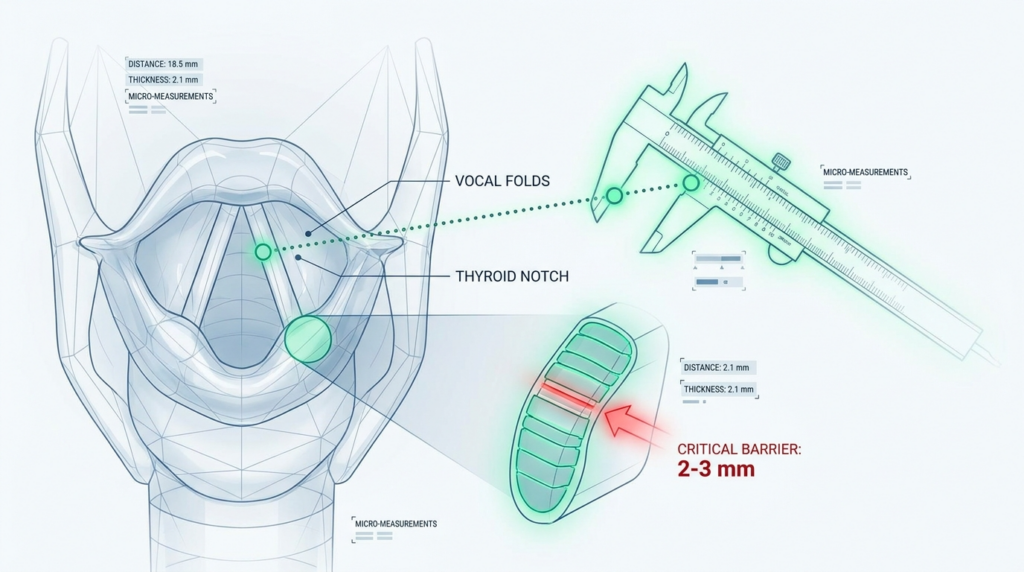
Table of Contents
The Hidden Anatomy of the Laryngeal Prominence
To understand the stakes of this procedure, one must look past the skin. The thyroid cartilage consists of two plate-like laminae that meet at an angle, creating the V-shaped protrusion known as the Adam’s apple. While the exterior looks uniform, the interior is a complex map of soft tissue attachments. The anterior commissure is the precise “V” where the left and right vocal folds converge and anchor to the cartilage. In many individuals, this attachment point sits surprisingly high—often just millimeters below the superior thyroid notch.
Consequently, the thickness of the cartilage wall is the only barrier between a surgical blade and your vocal integrity. If the surgeon lacks a detailed understanding of your specific laryngeal architecture, they are essentially operating in the dark. This is why tracheal shave vocal fold protection must be the primary focus of any consultation regarding Adam’s Apple Reduction (Tracheal Shave). A flat neck achieved at the expense of a resonant voice is not a successful surgery; it is a structural failure.
Defining the Danger Zone: The Anterior Commissure
The “Danger Zone” in a tracheal shave is defined by the vertical distance between the highest point of the thyroid notch and the attachment of the vocal folds. Surgeons often refer to this as the “Safety Buffer.” Research indicates that in many patients assigned male at birth, this buffer can be as narrow as 2 to 3 millimeters. Furthermore, the ossification—or hardening—of the cartilage as one ages makes it more brittle, increasing the risk of unintended fractures during the shaving process.
Instead of aiming for total flatness, a precision-oriented surgeon identifies the “Critical Point” where the cartilage begins to thin. This approach respects the biomechanics of the larynx. When the anterior commissure is compromised, the vocal folds lose their tension. Imagine a guitar string where the tuning peg is ripped out of the wood; the string can no longer vibrate at its intended frequency. This results in a voice that is breathy, weak, or permanently lowered in pitch—outcomes that are notoriously difficult to repair through secondary phonosurgery.
The Structural Paradox: Why More Reduction Isn’t Better
There is a common misconception that “more is better” in facial feminization. In reality, the goal is “Visual Softening,” not “Anatomical Erasure.” The structural paradox of the tracheal shave is that the most aggressive reductions often lead to the most masculine-coded voice changes. Specifically, a weakened laryngeal frame can cause the larynx to sit lower in the neck, which paradoxically increases the resonance space and deepens the voice.
Compare the outcomes of aggressive vs. protective techniques in the table below:
| Feature | Aggressive Resection | Protective Precision Shave |
|---|---|---|
| Visual Profile | Completely flat or concave | Softened, natural feminine contour |
| Vocal Stability | High risk of pitch drop/hoarseness | Preserved pitch and resonance |
| Structural Integrity | Risk of laryngeal collapse | Maintains cartilage framework |
| Recovery Path | Potential for long-term vocal fatigue | Standard healing (7–10 days) |
By choosing tracheal shave vocal fold protection, you are choosing a result that looks feminine in photographs and sounds feminine in conversation. This holistic approach is a cornerstone of advanced Facial Feminization Surgery – FFS. Precision is the difference between a patient who “passes” visually and one who feels confident in every social interaction.
Surgical Techniques for Voice Preservation
Modern surgical protocols have evolved to minimize guesswork. Elite surgeons no longer rely on external palpation alone. Instead, they utilize intraoperative techniques to map the internal landscape. One such method involves using a fine-gauge needle to “sound” the depth of the cartilage. By inserting the needle and observing its position via a laryngoscope, the surgeon can see exactly where the vocal folds attach before they ever touch a scalpel or burr to the cartilage.
Furthermore, the use of ultrasound or pre-operative CT scans allows for a bespoke surgical plan. These scans provide a 3D measurement of your “Safety Buffer.” If the scan shows that your anterior commissure is positioned high, the surgeon knows they must leave a “Shield” of cartilage to maintain tension. This technical rigor ensures that tracheal shave vocal fold protection is a measurable outcome rather than a hopeful aspiration. Additionally, some surgeons prefer the “Open Technique” over endoscopic methods because it provides a clearer direct view of the thyroid notch and the midline, reducing the chance of off-center shaving that can destabilize the larynx.
The Consequences of Over-Aggressive Resection
What happens when the “Safety Buffer” is ignored? The clinical term is “Vocal Fold Detachment,” but the lived experience is far more devastating. Initially, the patient may notice a persistent hoarseness that does not resolve after the swelling subsides. Because the vocal folds are no longer anchored firmly, they lose their ability to vibrate symmetrically. This leads to a condition known as diplophonia, where two different pitches are produced simultaneously, creating a “cracked” or unstable sound.
Moreover, the loss of the anterior commissure anchor can lead to “laryngeal web” formation—the growth of scar tissue across the airway. This not only ruins the voice but can also restrict breathing during physical exertion. This is why many experienced surgeons in the gender-affirming field warn against “Profile Chasing.” When a patient demands a perfectly straight line from the chin to the chest, the surgeon must have the ethical fortitude to explain the physiological limits. In this context, tracheal shave vocal fold protection acts as the final safeguard for the patient’s long-term quality of life.
Beyond the Shave: Integrated Laryngeal Safety
True laryngeal safety isn’t just about the thyroid cartilage; it involves the entire cricothyroid complex. The muscles surrounding the larynx, such as the cricothyroid muscle, are responsible for stretching the vocal folds to create high-pitched sounds. During a tracheal shave, a clumsy incision can damage these muscles or the nerves that supply them (specifically the external branch of the superior laryngeal nerve). Damage here doesn’t just lower the pitch; it removes the “Upper Register,” making it impossible for the patient to use a feminine head voice.
Therefore, the surgical approach must be minimally invasive regarding the soft tissues. A “Voice-First” surgeon will meticulously dissect the strap muscles and move them aside, rather than cutting through them. This preservation of the “Laryngeal Elevator” mechanism ensures that after recovery, the patient can still engage in voice feminization therapy with full range. Tracheal shave vocal fold protection thus becomes an integrated effort between bone reduction and soft tissue management.
The Psychological Impact of Vocal Integrity
We often underestimate how much our identity is tied to our voice. For many trans women and non-binary individuals, the voice is a primary source of gender dysphoria. Achieving a feminine facial appearance through FFS only to lose vocal range is a recipe for a new, profound type of distress. When the voice no longer matches the face, the “Uncanny Valley” effect can trigger social anxiety and isolation. This is why the surgical community is increasingly viewing tracheal shave vocal fold protection as a mental health necessity.
A successful transition is built on harmony. The visual and auditory cues must align. If you are planning your surgery journey, do not let the desire for a “perfect profile” blind you to the value of your voice. A surgeon who tells you they can give you a “zero-bump” result without mentioning the anterior commissure is likely prioritizing aesthetics over anatomy. Seek a practitioner who values the “Foundational Voice” as much as the “Feminine Silhouette.”
Patient Checklist: Choosing a Voice-Safe Surgeon
If you are researching surgeons for your procedure, use the following steps to ensure your vocal health is the priority. These steps move beyond the standard “before and after” photos and get into the technical heart of the surgery.
- Inquire about Intraoperative Mapping: Ask the surgeon exactly how they identify the attachment point of the vocal folds during the operation. Do they use a “sounding needle,” laryngoscopy, or ultrasound? A surgeon with a clear protocol is a surgeon who prioritizes tracheal shave vocal fold protection.
- Evaluate the CT Scan Requirement: Does the clinic require a pre-operative CT scan of the neck? High-resolution imaging is the most reliable way to measure cartilage thickness and “Safety Buffer” distance. If they skip this, they are guessing your anatomy.
- Discuss the “Profile Goal”: Be wary of any provider who promises a 100% flat neck to every patient. A responsible surgeon will explain that your unique anatomy determines the limit of the reduction. This honesty is a sign of clinical expertise.
- Review Nerve Preservation Techniques: Ask how they protect the superior laryngeal nerve and the cricothyroid muscles. Their answer should involve meticulous dissection rather than aggressive cutting.
- Verify Post-Op Voice Support: Does the surgeon work with speech-language pathologists? A clinic that understands the relationship between surgery and voice therapy offers a more holistic recovery path.
Protecting your vocal folds is a non-negotiable part of gender-affirming care. By focusing on these technical details, you ensure that your journey toward femininity is both safe and empowering. Your voice is your power; do not trade it for a profile. To discuss your specific anatomical needs with experts who prioritize your safety, Contact us today for a specialized consultation.
Frequently Asked Questions
What is the anterior commissure and why is it dangerous during a tracheal shave?
The anterior commissure is the specific internal point where your vocal folds attach to the thyroid cartilage. During a tracheal shave, if the surgeon removes too much bone in this area, the vocal folds can become detached. This leads to a permanent loss of voice tension, resulting in a deeper, breathy, or completely unstable voice that is extremely difficult to surgically correct.
Can a tracheal shave make my voice deeper permanently?
Yes, if the procedure is performed without proper vocal fold protection. If the cartilage supporting the vocal folds is weakened or if the attachment point is compromised, the tension on the vocal folds decreases. This lack of tension causes the pitch of your voice to drop. In some cases, aggressive shaving can also lead to the larynx sitting lower in the neck, further deepening the resonance.
How do surgeons know where the ‘safe’ limit for shaving is?
Modern surgeons use several techniques to identify the safety limit. This includes pre-operative CT scans to measure cartilage thickness, and intraoperative sounding where a fine needle is used to locate the vocal fold attachment point. By observing the needle’s position through a camera in the throat (laryngoscopy), the surgeon can mark the exact ‘Danger Zone’ and avoid it during the shave.
Will I lose my ability to do voice feminization therapy after a tracheal shave?
If the tracheal shave is performed correctly with a focus on vocal fold protection, your ability to perform voice therapy should be unaffected. However, if the cricothyroid muscles or the superior laryngeal nerve are damaged during the incision, you may lose your ‘Upper Register’ or head voice. This makes it significantly harder to achieve a feminine pitch through therapy, highlighting the need for a surgeon who respects laryngeal anatomy.
 English (United States)
  English (UK)
  Spanish
  Dutch
Dutch  German
  Arabic
  French
  Russian