


What if the secret to a naturally feminine midface isn’t just filler or fat grafting—but a structural transformation few surgeons dare to address? The “sunken” look that shadows the cheeks and flattens the nasal base isn’t merely a soft-tissue issue. It’s a skeletal one. And for those undergoing facial feminization surgery (FFS), paranasal augmentation isn’t just an option—it’s the missing link that redefines the entire midface, from the nasolabial angle to the very foundation of the nose.
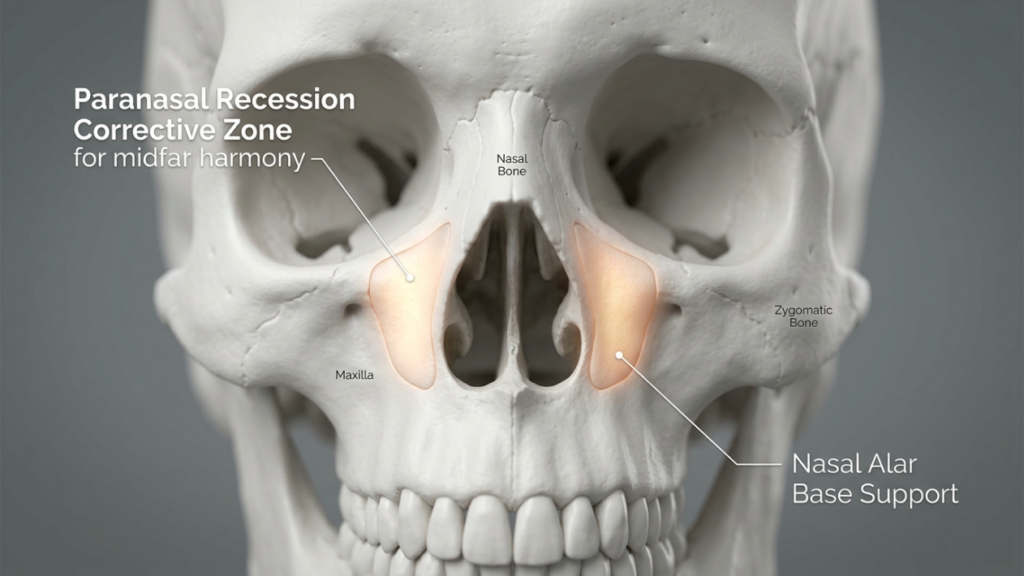
Here’s the truth no one tells you: Most feminization rhinoplasties fail to achieve true harmony because they ignore the piriform aperture—the bony gateway that dictates nasal projection, midface fullness, and even the illusion of lip volume. Without addressing this critical junction, even the most refined rhinoplasty will sit awkwardly, like a sculpture perched on an unstable pedestal. Paranasal augmentation, whether through PEEK implants or precision bone grafting, doesn’t just “fill” the midface. It rebuilds the skeletal framework that makes femininity look effortless, not engineered.

Table of Contents
Why the Midface Concavity Is More Than an Aesthetic Flaw—It’s a Biomechanical One
The midface isn’t just a canvas for contouring—it’s a load-bearing structure that influences everything from breathing to facial expression. When the maxillary retrusion creates a concave appearance, it doesn’t just affect how you look. It alters how your face functions. Studies in craniofacial orthodontics reveal a startling correlation: Patients with midface retrusion are 40% more likely to experience nasal airway resistance, a condition that exacerbates breathing difficulties and even sleep disturbances. This isn’t just about passing as female. It’s about reclaiming the physiological ease that comes with a balanced skeletal foundation.
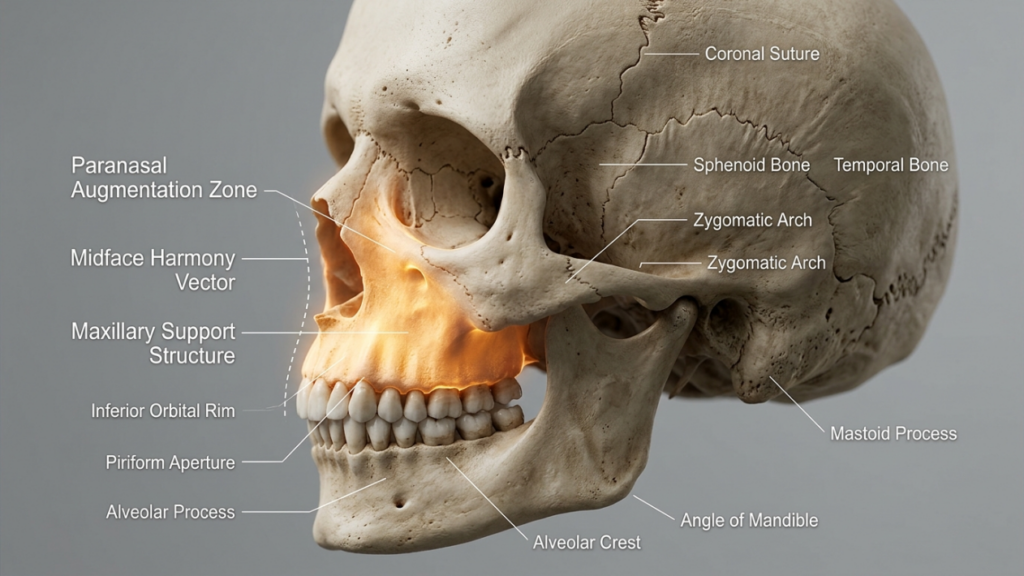
But here’s where it gets counterintuitive: The same retrusion that flattens the midface also disrupts the nasolabial angle, the critical 95–115° junction where the nose meets the upper lip. In cisgender women, this angle is naturally more obtuse, creating the illusion of a lifted, fuller lip. In trans women with midface retrusion, this angle collapses, making the nose appear longer and the lips thinner—regardless of how much filler is injected. The result? A face that looks perpetually “underfilled,” no matter how much volume is added. Paranasal augmentation doesn’t just restore projection. It re-engineers the entire nasolabial complex, turning a structural liability into an aesthetic advantage.
PEEK Implants vs. Bone Grafting: The Battle for the Piriform Aperture
Not all paranasal augmentations are created equal. The choice between PEEK implants and bone grafting isn’t just about material—it’s about philosophy. PEEK (polyether ether ketone) implants are the precision instruments of midface augmentation. Custom-milled to fit the piriform aperture like a glove, they offer predictable, stable projection without the unpredictability of organic grafts. But they come with a trade-off: While PEEK integrates with the surrounding bone over time, it remains a foreign body—one that demands flawless placement to avoid complications like infection or displacement.
| Factor | PEEK Implants | Bone Grafting |
|---|---|---|
| Precision | ✓ Custom-milled for exact fit | ✗ Dependent on donor site and surgeon’s skill |
| Stability | ✓ Immediate, predictable projection | ✓ Integrates with native bone over time |
| Invasiveness | ✓ Minimal donor site morbidity | ✗ Requires secondary surgical site (rib, hip, or skull) |
| Longevity | ✓ Permanent, but risks infection/displacement | ✓ Remodels with facial aging; less risk of rejection |
| Cost | ✗ Higher upfront cost (custom fabrication) | ✓ Lower material cost, but longer OR time |
| Ideal Candidate | Patients needing targeted, moderate augmentation | Patients requiring extensive reconstruction or who prefer organic materials |
Bone grafting, on the other hand, is the organic alternative. Harvested from the patient’s own rib, hip, or skull, these grafts fuse with the native bone, creating a seamless, living extension of the midface. The catch? Bone grafts are unpredictable. They resorb at variable rates (up to 30% in the first year), and their success hinges on the surgeon’s ability to shape and secure them without compromising vascularity. For patients with severe maxillary retrusion, bone grafting may be the only option—but for those seeking subtle, controlled augmentation, PEEK is often the superior choice.
Then there’s the wildcard: LeFort I osteotomy. While not a standalone procedure for paranasal augmentation, it’s the nuclear option for patients with extreme midface retrusion. By surgically advancing the entire maxilla, LeFort I doesn’t just augment the piriform aperture—it repositions it, creating dramatic changes in nasal projection, lip support, and even cheekbone definition. But this is major surgery, reserved for cases where paranasal implants or grafts alone can’t achieve the desired transformation. The recovery is longer, the risks higher, and the results—while undeniably powerful—require a level of commitment most patients aren’t prepared for.
The Nasolabial Angle Paradox: How Paranasal Augmentation Tricks the Eye Into Seeing a Feminine Nose
Here’s the optical illusion no one talks about: A truly feminine nose isn’t just about the tip or the bridge—it’s about the base. The nasolabial angle, that critical junction between the columella and the upper lip, is the unsung hero of nasal aesthetics. In cisgender women, this angle averages 105–115°, creating the illusion of a slightly upturned, delicate nose. In trans women, especially those with midface retrusion, this angle often collapses to 85–95°, making the nose appear droopy, heavy, and disproportionately long—even if the rhinoplasty itself is flawless.

Paranasal augmentation changes the game by repositioning the skeletal foundation that the nose sits on. By projecting the piriform aperture forward, it effectively “lifts” the nasal base, increasing the nasolabial angle without touching the nose itself. This is why the best feminization rhinoplasties often include paranasal augmentation as a first step. Without it, the surgeon is left trying to compensate for a structural deficiency with soft-tissue manipulation alone—a losing battle. With it, the nose doesn’t just look smaller or more refined. It looks natural, as if it was always meant to sit that way.
But the benefits don’t stop at the nose. The same skeletal shift that opens the nasolabial angle also enhances lip volume—without a single syringe of filler. By projecting the maxilla forward, paranasal augmentation creates the illusion of a fuller, more defined vermilion border. This is the secret behind the “lip lift” effect that so many trans women chase with temporary fillers. The difference? It’s permanent. And it’s not just about volume. It’s about support. A lip that sits on a projected maxilla looks naturally plump, not artificially inflated. It moves with the face, not against it. And it ages gracefully, without the telltale signs of overfilled lips.
The Midface Projection Myth: Why Most Fillers Fail (And How to Fix It)
If you’ve ever had filler injected into your midface only to watch it dissolve into a featureless blob, you’re not alone. The midface is a high-mobility zone, and filler placed without skeletal support is doomed to migrate. Most injectors target the malar eminence (the cheekbone’s highest point), but this is a mistake. The true anchor of midface projection isn’t the cheekbone—it’s the piriform aperture. Without addressing this deeper structure, filler is like building a house on sand. It may look good for a few months, but it won’t last.
Paranasal augmentation solves this problem by creating a stable platform for soft-tissue augmentation. Whether you opt for fat grafting, hyaluronic acid fillers, or even future biostimulatory treatments, the results will be more predictable, more durable, and more natural-looking when the skeletal foundation is secure. This is why the best FFS surgeons often combine paranasal augmentation with fat grafting in a single procedure. The fat is placed in the submalar space, where it’s supported by the newly projected maxilla, creating a smooth, seamless transition from the nose to the cheeks. The result? A midface that looks full, not puffy—elevated, not exaggerated.
The Recovery Reality: What to Expect After Paranasal Augmentation
Paranasal augmentation isn’t a minor procedure. Whether you choose PEEK implants or bone grafting, the recovery demands patience—and a willingness to embrace the temporary “overdone” look. Here’s what no one tells you about the first 90 days:
- Week 1: The “Sausage Face” Phase. Swelling peaks at day 3–5, and it’s not subtle. Your midface will look puffy, your nose may appear wider, and your upper lip might seem unnaturally projected. This is normal. The swelling masks the final result, and it’s easy to panic—but resist the urge to ice excessively. Cold therapy can compromise blood flow to the grafts or implants, increasing the risk of complications.
- Week 2–4: The Great Deflation. By the end of the second week, the swelling starts to subside, revealing the first hints of your new skeletal framework. This is when the psychological shift happens. You’ll catch glimpses of the changes in the mirror—maybe a softer nasolabial angle, or a more defined cheek contour. But you’ll also notice asymmetry. This is temporary. Bone grafts, in particular, can shift slightly as they integrate, and PEEK implants may settle into their final position over weeks, not days.
- Week 6–12: The Reveal. By the two-month mark, 80% of the swelling is gone, and the true impact of the augmentation becomes visible. This is when you’ll see the nasolabial angle open up, the midface projection stabilize, and the nose appear more harmonious. But the final result? That takes six months—or longer, if you’ve had bone grafting. Bone remodels slowly, and the grafts continue to integrate and strengthen for up to a year.
- Month 6+: The Subtle Refinements. The last 20% of the result is the most rewarding. As the tissues fully adapt to the new skeletal framework, the midface takes on a natural, effortless fullness. The nose sits more gracefully, the lips appear more defined, and the entire face achieves a balance that filler alone could never replicate. This is the phase where patients often say, “I don’t just look different—I look like me.”
But recovery isn’t just physical. The psychological adjustment can be just as intense. Seeing your face transform in the mirror is exhilarating—but it can also be disorienting. Many patients experience a period of dysphoria rebound, where the sudden visibility of their changes triggers unexpected emotions. This is normal. Your brain needs time to reconcile the image in the mirror with your internal sense of self. For some, this adjustment period is seamless. For others, it’s a rollercoaster. The key? Give yourself permission to feel whatever comes up, without judgment. And if you need support, seek out a therapist who specializes in gender-affirming care. You’re not just healing a surgical site. You’re rewiring your relationship with your reflection.
The Long-Term Payoff: How Paranasal Augmentation Ages (Spoiler: Better Than Filler)
Here’s the dirty little secret of midface fillers: They don’t age well. Hyaluronic acid breaks down, fat grafts resorb, and what once looked like natural volume can turn into a sagging, amorphous mass. But paranasal augmentation? It’s the gift that keeps on giving. Because it addresses the skeletal foundation, not just the soft tissue, the results are far more durable—and far more resistant to the effects of aging.
As we age, the maxilla naturally retrudes, the piriform aperture widens, and the midface loses projection. This is why so many older cisgender women develop a “sunken” look, even if they’ve had filler in the past. Paranasal augmentation doesn’t just restore youthful projection—it future-proofs the midface. By establishing a strong skeletal framework early, you’re essentially putting the brakes on the aging process. The soft tissues have a stable platform to rest on, which means they’re less likely to descend into jowls or nasolabial folds. And because the augmentation is structural, not superficial, it moves with your face, not against it.
But the real long-term benefit? Confidence. A midface that’s supported by a strong skeletal foundation doesnth just look better—it feels better. There’s no constant cycle of filler touch-ups, no anxiety about migration or overfilling. There’s just a face that looks like it was always meant to be yours. And that’s a payoff no temporary treatment can match.
Is Paranasal Augmentation Right for You? The 5-Point Checklist
Paranasal augmentation isn’t for everyone. But if you’re considering facial feminization surgery (FFS) and any of the following apply to you, it might be the missing piece of your transformation:
- Your nasolabial angle is less than 95°. If your nose appears droopy or your upper lip looks thin, skeletal support could redefine your profile.
- Your midface looks flat or concave in profile. This isn’t just about volume—it’s about structure. If your cheeks lack projection even with filler, the issue may be skeletal.
- You’ve had rhinoplasty but still feel your nose looks “off.” If your nose sits awkwardly on your face, the problem may not be the nose itself—but the foundation it’s built on.
- You’re tired of filler migrations and touch-ups. If your midface filler never seems to stay put, it’s a sign your skeletal support is lacking.
- You want results that last a decade, not a year. If you’re ready to invest in a permanent solution, paranasal augmentation offers durability that filler can’t match.
But here’s the caveat: Paranasal augmentation is a commitment. The recovery is longer than a typical filler session, the cost is higher, and the results—while transformative—aren’t immediate. If you’re looking for a quick fix, this isn’t it. But if you’re ready to address the root cause of midface concavity and nasal dishharmony, it’s the most powerful tool in FFS.
The Final Verdict: Why Paranasal Augmentation Is the Unsung Hero of FFS
Facial feminization surgery isn’t just about softening features or reducing angles. It’s about rebuilding the skeletal framework that makes femininity look natural, not forced. And nowhere is this more evident than in the midface. Paranasal augmentation doesn’t just fill gaps—it re-engineers the very foundation of your face, creating a harmony that extends from the brows to the chin. It’s the difference between a face that looks feminized and one that looks effortlessly female.
If you’re considering FFS, ask your surgeon about paranasal augmentation. Not all FFS providers offer it—many focus on the forehead, jaw, and nose while neglecting the critical midface support. But the best surgeons know this: True feminization isn’t just about what you remove. It’s about what you build. And in the quest for a face that aligns with your identity, paranasal augmentation might just be the missing link you’ve been searching for.
Ready to explore how paranasal augmentation can transform your midface and nasal harmony? Schedule a consultation with our team today. Your journey to a face that feels like home starts here.
FAQ
How does paranasal augmentation differ from midface fillers?
Paranasal augmentation addresses the skeletal foundation of the midface, specifically the piriform aperture, while fillers only add temporary volume to the soft tissue. Without skeletal support, fillers often migrate or dissolve unevenly, leading to an unnatural appearance. Paranasal augmentation provides a stable platform for fillers or fat grafting, ensuring long-lasting, harmonious results.
Can paranasal augmentation be combined with rhinoplasty?
Absolutely. In fact, the best feminization rhinoplasties often include paranasal augmentation as a first step. By projecting the piriform aperture forward, paranasal augmentation enhances the nasolabial angle and provides a stronger foundation for the nose. This combination ensures that the nose doesn’t just look refined—it looks naturally integrated with the rest of the face.
What are the risks of PEEK implants for paranasal augmentation?
PEEK implants are generally safe but carry risks like infection, displacement, or improper integration with the surrounding bone. These risks are minimized by choosing an experienced surgeon who custom-mills the implants for a precise fit. Unlike bone grafts, PEEK implants don’t resorb, but they require flawless placement to avoid long-term complications.
How long does it take to see the final results of paranasal augmentation?
Initial results are visible within 6–8 weeks, but the final outcome can take up to 6–12 months, especially if bone grafting is involved. Bone grafts continue to integrate and remodel over time, while PEEK implants settle into their final position within a few months. Swelling and asymmetry are normal during the early recovery phase, so patience is key.
Is paranasal augmentation reversible?
PEEK implants can be removed or revised if necessary, but bone grafts are permanent once they integrate with the native bone. Reversal is rare, as most patients are satisfied with the results. However, it’s important to choose a surgeon who understands the long-term implications of skeletal augmentation and can tailor the procedure to your unique anatomy.
Does paranasal augmentation affect breathing or nasal function?
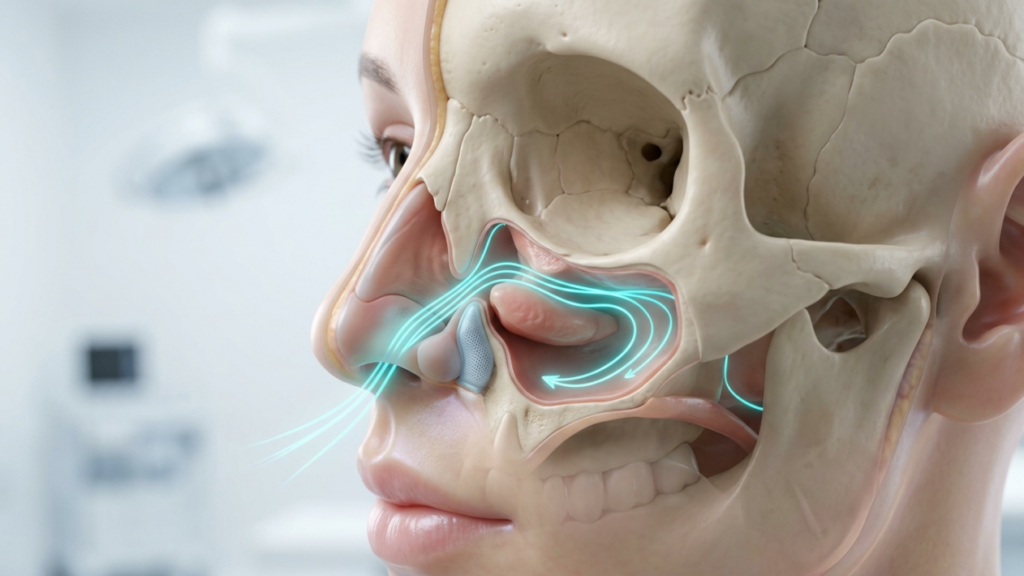
When performed correctly, paranasal augmentation should not negatively impact breathing or nasal function. In fact, for patients with midface retrusion, the procedure can improve nasal airway resistance by repositioning the skeletal framework. However, it’s crucial to choose a surgeon with expertise in both aesthetic and functional aspects of midface augmentation to avoid complications.
Can paranasal augmentation be performed on patients with previous midface surgeries?
Yes, but it depends on the extent of the previous surgeries and the current skeletal structure. Patients with prior midface procedures may require a customized approach, such as combining PEEK implants with bone grafting or fat transfer. A thorough consultation with an experienced FFS surgeon is essential to determine the best course of action for revision cases.
How does paranasal augmentation enhance lip volume?
Paranasal augmentation projects the maxilla forward, which naturally lifts the upper lip and enhances its fullness. This creates the illusion of a more defined vermilion border without the need for fillers. The result is a lip that looks naturally plump and supported, rather than artificially inflated. This effect is particularly beneficial for trans women seeking a softer, more feminine lip contour.
 English (UK)
  English (United States)
  Spanish
  Dutch
Dutch  German
  Arabic
  French
  Russian