


Imagine spending thousands on V-line jaw surgery, only to watch your face gradually widen again—like a time-lapse of your old jaw reclaiming its territory. This isn’t a horror story. It’s the reality for patients who overlook one critical detail: the masseter muscle doesn’t just adapt to your new bone structure—it fights back.
Here’s the truth no surgeon will say upfront: bone removal alone doesn’t guarantee a permanently slim jawline. The masseter, that thick band of muscle anchoring your jaw, has a memory. And if you don’t intervene at the exact right moment, it will bulk up to compensate for the lost bone, filling the space you paid to empty. The result? A jaw that looks sculpted in photos but feels heavy in person—and slowly loses its definition.
Table of Contents
Why Your Jaw Isn’t Done Healing After Surgery (And Why That’s Dangerous)
Most patients believe their jaw’s transformation ends when the surgeon sets down the scalpel. In reality, that’s when the real battle begins. Here’s what’s happening beneath your skin in the months after V-line surgery:
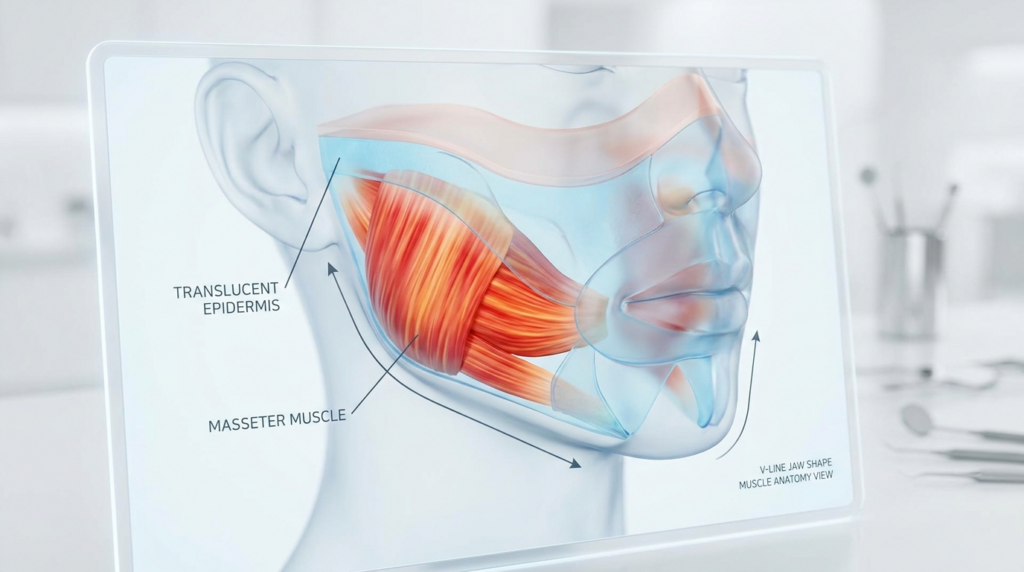
- The Bone’s “Empty Space” Problem: When the mandibular angle is shaved or the chin is narrowed, the masseter suddenly has less structural support. Your brain interprets this as instability and signals the muscle to grow thicker to “fill the gap.” This is why patients with naturally square jaws often develop masseteric hypertrophy—it’s the body’s way of reinforcing a perceived weak point.
- Compensatory Hypertrophy: After bone removal, the posterior fibers of the masseter (the part closest to your ear) often overdevelop. Why? Because they’re the last line of defense against the altered mechanics of your bite. This overgrowth isn’t just cosmetic—it can lead to chronic tension, teeth grinding, and even TMJ disorders if left unchecked.
- The 3-Month Window of Opportunity: Research in Plastic and Reconstructive Surgery Global Open shows that the masseter’s adaptive growth peaks around 12 weeks post-surgery. This is your golden window to intervene with Botox before the muscle “sets” into its new shape. Miss it, and you’re playing catch-up with a muscle that’s already rewired itself.

The Masseter Botox Timeline: When to Inject for Maximum Slimming
Timing isn’t just important—it’s everything. Inject too early, and you risk disrupting the initial healing of the bone. Inject too late, and you’re trying to shrink a muscle that’s already bulked up to compensate. Here’s the exact protocol used by top facial feminization surgeons (and why most clinics get it wrong):
| Post-Op Week | What’s Happening in Your Jaw | Botox Strategy | Why This Matters |
|---|---|---|---|
| 0–4 | Bone healing, swelling, and acute inflammation. The masseter is temporarily weakened from surgical trauma. | No Botox. The muscle is already in a vulnerable state—adding neurotoxin now could impair its ability to stabilize the jaw during early healing. | Premature Botox can lead to uneven muscle atrophy, creating a “lopsided” jawline that’s difficult to correct later. |
| 5–8 | Swelling subsides, and the bone begins to solidify. The masseter starts to “wake up” and test its new range of motion. | Low-Dose Botox (10–15 units per side). Target only the posterior fibers (the thickest part, near the ear). This prevents compensatory hypertrophy without interfering with the muscle’s role in chewing. | This is when most clinics stop—but it’s just the first phase. Early intervention prevents the masseter from overdeveloping, but it doesn’t guarantee long-term slimming. |
| 9–12 | The masseter’s adaptive growth peaks. If no intervention has occurred, the muscle will start to bulk up to fill the space left by bone removal. | Full Therapeutic Dose (20–25 units per side). Now, the entire masseter—including the anterior fibers—can be safely treated. The goal shifts from prevention to reshaping. | This is the make-or-break moment. Injecting at this stage ensures the muscle atrophies evenly, creating a smooth, tapered jawline that complements the V-line surgery. |
| 13–24 | The bone is fully healed, and the masseter’s new shape begins to “set.” Without intervention, the muscle will maintain its bulk. | Maintenance Doses (15–20 units per side, every 4–6 months). The masseter has a long memory—if you stop Botox now, it will gradually return to its pre-surgery size. | Think of this as “orthodontics for your jaw.” Just as braces require retainers, your jaw needs ongoing Botox to maintain its slimmed shape. |
Most clinics either skip the early intervention (weeks 5–8) or stop after the first dose. This is why so many patients see temporary results that fade within a year. The masseter doesn’t just need to be weakened—it needs to be re-educated.
The Science Behind Why This Works (And Why Most Patients Don’t Know About It)
Masseter Botox isn’t just a cosmetic quick fix—it’s a functional intervention that exploits the muscle’s natural adaptation cycle. Here’s what’s really happening when you inject at the right time:
- Neuromuscular Re-education: Botox (botulinum toxin type A) blocks the release of acetylcholine, the neurotransmitter that tells your muscle to contract. Over time, this forces the masseter to “forget” its old contraction patterns. When you inject during the 3-month window, you’re essentially rewiring the muscle to adapt to your new bone structure—not the other way around.
- The “Use It or Lose It” Principle: Muscles atrophy when they’re not used. By temporarily weakening the masseter, Botox forces your brain to recruit other muscles (like the temporalis) for chewing. This redistribution of labor prevents the masseter from bulking up to compensate for the lost bone.
- Collagen Remodeling: Studies in Aesthetic Plastic Surgery show that repeated Botox injections can actually alter the collagen structure within the masseter, making it less dense over time. This is why patients who maintain their Botox schedule often see permanent slimming—even when they eventually stop treatments.
But here’s the catch: this only works if the injections are timed to coincide with the muscle’s natural adaptation cycle. Inject too early, and you disrupt the healing process. Inject too late, and the muscle has already “set” into its new shape—making it resistant to atrophy.
What Happens If You Skip Botox (Or Get the Timing Wrong)
Let’s be clear: V-line surgery will still change the shape of your jaw without Botox. But without addressing the masseter, you’re only treating half the problem. Here’s what patients who skip Botox (or get the timing wrong) often experience:
- The “Heavy Jaw” Illusion: Even with a perfectly sculpted bone, a thick masseter can make your jaw feel heavy and masculine. This isn’t just psychological—it’s a physical sensation caused by the muscle’s bulk pressing against the skin. Many patients report that their jaw looks slim in photos but feels “blocky” in person.
- Asymmetry Nightmares: If Botox is injected too early (before week 5), the masseter can atrophy unevenly. This creates a lopsided jawline that’s difficult to correct—even with surgery. The most common pattern? The treated side slims down while the untreated side bulks up, creating a “twisted” appearance.
- The “Rebound Effect”: Patients who stop Botox after the first dose often see their masseter bulk up even more than before surgery. Why? Because the muscle has been temporarily weakened, forcing it to overcompensate when it regains strength. This is why maintenance doses are non-negotiable for long-term results.
- TMJ and Bite Problems: The masseter isn’t just for show—it plays a crucial role in chewing and jaw stability. Over-weakening it (or injecting at the wrong time) can lead to TMJ disorders, chronic headaches, and even difficulty opening your mouth. This is why precision matters: you want to slim the muscle, not paralyze it.
How to Work With Your Surgeon to Get This Right
Not all surgeons are created equal—and when it comes to masseter Botox, many are stuck in the past. Here’s how to ensure you’re getting the right protocol:
- Ask About Their Botox Timeline Before Surgery. If they say, “We’ll figure it out after,” run. A surgeon who understands the masseter’s role in jaw contouring will have a precise injection schedule planned in advance.
- Demand a 3-Phase Approach. The best surgeons use a tiered strategy: prevention (weeks 5–8), reshaping (weeks 9–12), and maintenance (every 4–6 months). If your surgeon only mentions one injection, they’re cutting corners.
- Insist on Ultrasound-Guided Injections. The masseter isn’t a uniform muscle—it has thick and thin areas, and injecting the wrong spot can lead to asymmetry or functional problems. Ultrasound guidance ensures the Botox is delivered to the exact fibers that need it.
- Request a Chewing Test Before Each Session. A simple way to gauge your masseter’s strength is to have you chew on a piece of gauze. If one side feels stronger than the other, the Botox needs to be adjusted to balance it out.
- Schedule Your Maintenance Doses Before You Leave the Clinic. Most patients forget to follow up—and by the time they remember, the masseter has already started to rebound. Lock in your next appointment before you’re discharged.
The Long-Term Play: How to Keep Your Jaw Slim for Years
Masseter Botox isn’t a one-and-done treatment. But with the right strategy, you can gradually reduce your reliance on injections while maintaining your results. Here’s how:
- Start with a Conservative Dose. It’s easier to add more Botox later than to correct over-treatment. Begin with 15–20 units per side and adjust based on your muscle’s response.
- Combine with Jawline Exercises (But Not Too Soon). Once your bone is fully healed (around 6 months post-surgery), gentle jawline exercises can help maintain definition. Focus on movements that engage the temporalis (like side-to-side chewing) rather than the masseter.
- Use a Night Guard If You Grind Your Teeth. Bruxism (teeth grinding) is the masseter’s worst enemy—it constantly works the muscle, encouraging hypertrophy. A custom night guard can reduce this stimulation, helping your Botox results last longer.
- Gradually Increase the Time Between Sessions. After 18–24 months of consistent Botox, many patients can stretch their maintenance doses to every 6–8 months. This is because the muscle’s collagen structure has remodeled, making it less prone to bulking up.
- Consider Radiofrequency Microneedling for Skin Tightening. As the masseter atrophies, the skin over your jawline can start to sag. Radiofrequency microneedling (like Morpheus8) stimulates collagen production, helping the skin tighten around your new, slimmer jawline.
The Bottom Line: Masseter Botox Isn’t Optional—It’s Essential
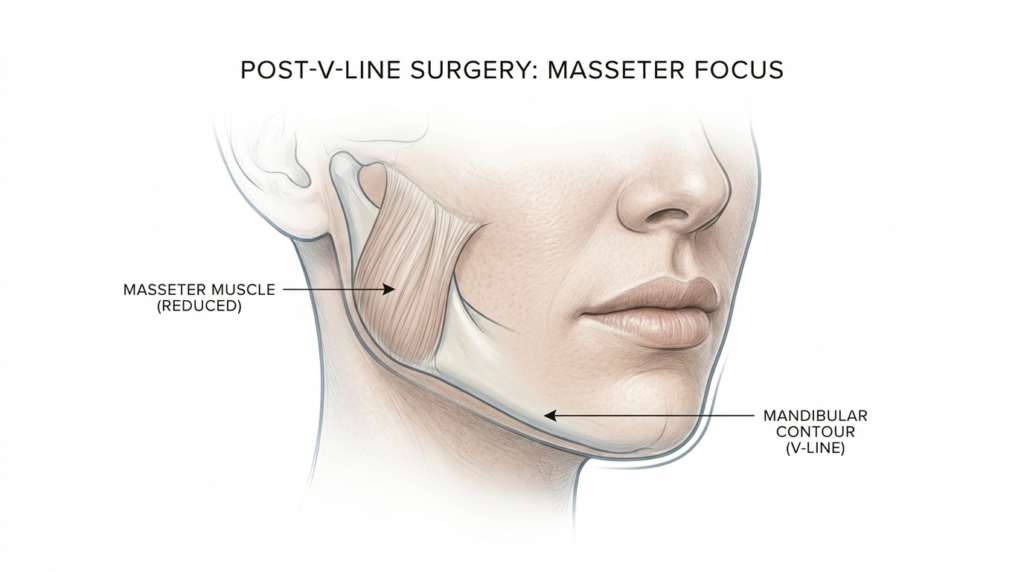
If you’re investing in V-line surgery, you’re not just paying for bone removal—you’re paying for a permanently slimmer jawline. But bone is only half the equation. The masseter is the silent saboteur that can undo all your surgeon’s work if you don’t address it at the right time.
The key takeaway? Masseter Botox isn’t an add-on—it’s a critical part of the V-line recovery process. When timed correctly, it doesn’t just enhance your results—it locks them in. Skip it, and you’re leaving your jaw’s final shape to chance.
Ready to take control of your jaw’s transformation? Schedule a consultation with our team to discuss a personalized masseter Botox timeline tailored to your V-line surgery. Your slimmer, more defined jawline starts now.
 English (United States)
  English (UK)
  Spanish
  Dutch
Dutch  German
  Arabic
  French
  Russian