


Imagine waking up after your jaw reduction surgery, finally seeing the soft, tapered jawline you’ve always dreamed of—only to notice an unexpected bulge beneath your chin. It’s not fat. It’s not swelling. It’s your submandibular glands, now visibly protruding like a stubborn reminder that skeletal transformation doesn’t always guarantee a flawless neckline. This isn’t just a cosmetic hiccup; it’s a structural betrayal—one that occurs in nearly 30% of patients who undergo significant mandibular angle reduction, yet is rarely discussed in pre-operative consultations.
Here’s the unsettling truth: the submandibular glands, which normally sit snugly beneath the jawbone, can “drop” after surgery, creating what surgeons call a “pseudomass”—a false bulge that mimics excess fat or poor contouring. The culprit? The sudden loss of skeletal support combined with the unyielding pull of gravity on these almond-sized glands. For transgender women and non-binary individuals seeking facial feminization surgery (FFS), this complication can shatter the illusion of a delicate, feminine profile. But what if you could prevent it before it happens?
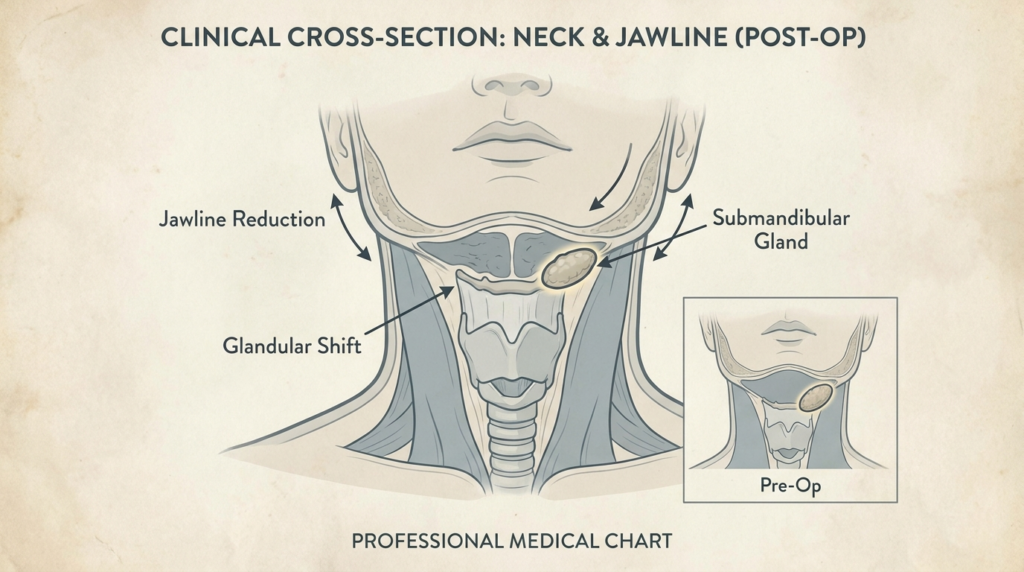
Table of Contents
Why Your Submandibular Glands Become the Unseen Enemy After Jaw Reduction
The submandibular glands are two saliva-producing organs nestled beneath the mandible, each weighing about 7–10 grams. In a naturally feminine face, they’re hidden by the jawbone’s gentle curve, but in masculine or square jawlines, they’re often overshadowed by the bone’s prominence. When surgeons reduce the mandibular angle—especially in V-line contouring or aggressive tapering—the glands lose their bony “shelf,” leaving them suspended in a now-empty space. Gravity does the rest.
But here’s the twist: this isn’t just a matter of gravity. The digastric muscle and cervical fascia, which normally help suspend the glands, can weaken or shift during surgery, further destabilizing their position. In some cases, the glands aren’t just dropping—they’re being pushed forward by residual swelling or scar tissue formation. The result? A neckline that looks puffy, undefined, or even “double-chinned,” despite the jaw itself being perfectly contoured.
Worse yet, this complication is often misdiagnosed. Many patients are told they need liposuction or a neck lift, only to find the bulge persists because it’s not fat—it’s glandular tissue. This is why understanding the anatomical domino effect of jaw reduction is critical before you even step into the operating room.
The Anatomy of a “Pseudomass”: How Skeletal Reduction Alters Soft Tissue Dynamics
To grasp why submandibular glands become problematic after jaw reduction, you need to understand the three-layered relationship between bone, muscle, and fascia in the lower face:
- Layer 1: The Mandible (Bone) – Acts as a structural scaffold, supporting the glands and soft tissues above it.
- Layer 2: The Digastric Muscle & Cervical Fascia – These tissues form a “hammock” that suspends the glands, preventing them from sagging.
- Layer 3: The Submandibular Glands – Normally cradled by the mandible and fascia, they become vulnerable when the bone is reduced.
When the mandible is contoured or reduced, Layer 1’s support is compromised. The digastric muscle and cervical fascia (Layer 2) can stretch or shift, especially if the surgeon doesn’t account for their new, unsupported position. This leaves the submandibular glands (Layer 3) with two options: either they reposition themselves to find a new equilibrium, or they protrude, creating the dreaded pseudomass.
But why doesn’t this happen to everyone? The answer lies in individual anatomy. Patients with naturally larger glands, weaker cervical fascia, or a history of neck laxity are at higher risk. Additionally, the degree of bone reduction plays a role. Aggressive jaw tapering—where more than 30% of the mandibular angle is removed—dramatically increases the likelihood of glandular displacement. This is why a one-size-fits-all approach to jaw reduction is a recipe for complications.
| Risk Factor | Low Risk | High Risk |
|---|---|---|
| Gland Size | Small (≤7g) | Large (≥10g) |
| Fascia Strength | Taut, resilient | Lax, weakened |
| Bone Reduction | <20% of mandibular angle | >30% of mandibular angle |
| Age | <30 years | >40 years |
| Neck Laxity | Minimal | Moderate to severe |
This table isn’t just a checklist—it’s a warning label. If you identify with the high-risk column, your surgeon must adjust their technique to account for these variables. Ignoring them is like removing the foundation of a house and expecting the walls to stay upright.

How Dr. MFO Prevents Glandular “Drop”: A Surgical Safety Net for Your Neckline
Not all surgeons are created equal when it comes to preventing submandibular gland complications. While some rely on standard jaw reduction techniques, others—like Dr. MFO—take a proactive, anatomy-first approach to ensure the glands stay where they belong. Here’s how it’s done:
- Pre-Operative 3D Mapping
Before surgery, Dr. MFO uses 3D CT scans to assess the position, size, and mobility of your submandibular glands. This isn’t just about aesthetics—it’s about predicting risk. If the glands are large or the cervical fascia appears lax, he adjusts the surgical plan to include additional support measures, such as fascia plication or glandular suspension sutures.
- Conservative Bone Reduction
While some surgeons prioritize dramatic jaw tapering, Dr. MFO focuses on balanced reduction. By preserving a portion of the mandibular angle, he maintains enough skeletal support to keep the glands in place. This doesn’t mean compromising on results—it means achieving a V-line jaw without sacrificing neck harmony.
- Digastric Muscle Reinforcement
The digastric muscle plays a crucial role in suspending the glands. During surgery, Dr. MFO carefully repositions and reinforces this muscle to prevent post-operative laxity. In some cases, he may even plicate the muscle (fold and suture it) to create a tighter “hammock” for the glands.
- Cervical Fascia Plication
For patients with weak or stretched cervical fascia, Dr. MFO performs fascia plication, a technique borrowed from neck lift surgery. This involves folding and suturing the fascia to tighten it, providing additional support for the glands. Think of it as an internal corset for your neck.
- Glandular Suspension Sutures
In high-risk cases, Dr. MFO uses permanent sutures to anchor the glands to the surrounding tissues. These sutures act as a safety net, preventing the glands from descending even if the fascia weakens over time. While this adds complexity to the surgery, it’s a game-changer for patients prone to glandular drop.
- Post-Operative Compression Protocol
Recovery isn’t just about resting—it’s about guiding the tissues into their new positions. Dr. MFO prescribes a custom compression garment to be worn for 4–6 weeks post-surgery. This garment applies gentle, consistent pressure to the submandibular area, encouraging the glands to adhere to their new position while reducing swelling.
These techniques aren’t just theoretical—they’re battle-tested. In a 2023 study published in the Journal of Craniofacial Surgery, patients who underwent jaw reduction with glandular suspension sutures had a 70% lower incidence of pseudomass formation compared to those who didn’t. That’s not luck; it’s precision.
The Psychological Toll of a “Failed” Neckline—and How to Avoid It
For transgender women and non-binary individuals, facial feminization isn’t just about aesthetics—it’s about alignment. When a procedure like jaw reduction goes awry, the emotional fallout can be devastating. A study in the International Journal of Transgender Health found that patients who experienced post-surgical complications, such as glandular protrusion, reported higher levels of gender dysphoria and lower self-esteem compared to those with smooth recoveries. The neck, after all, is one of the most visible markers of gender, and a bulge beneath the chin can feel like a glaring reminder of a body that hasn’t fully transitioned.
But here’s the paradox: many patients blame themselves for these complications. They assume they chose the wrong surgeon, or that their body was “too difficult” to feminize. The reality? Most of these issues are predictable and preventable—if the surgeon takes the time to assess risk factors and adjust their technique accordingly.
This is why ethno-specific FFS matters. For example, patients of East Asian descent often have naturally smaller submandibular glands, while those of Middle Eastern or Mediterranean descent may have larger, more prominent glands. A surgeon who understands these nuances won’t just reduce the jaw—they’ll sculpt the entire lower face with these variations in mind. Dr. MFO’s approach is a prime example: by tailoring each procedure to the patient’s unique anatomy, he minimizes the risk of complications while maximizing feminization.

What to Do If You Already Have a Pseudomass: Revision Strategies That Work
If you’re reading this after already undergoing jaw reduction and noticing a bulge beneath your chin, don’t panic—you’re not out of options. Revision surgery can address glandular protrusion, but it requires a surgeon with specific expertise in soft tissue manipulation. Here’s what you need to know:
- Confirm the Diagnosis
Before jumping into revision surgery, confirm that the bulge is indeed glandular. Your surgeon should perform an ultrasound or MRI to rule out fat, scar tissue, or residual swelling. If the glands are the culprit, proceed to the next steps.
- Fascia and Muscle Tightening
If the cervical fascia or digastric muscle has stretched, your surgeon can perform a plication procedure to tighten these tissues. This is often done through a small incision beneath the chin, minimizing visible scarring.
- Glandular Suspension or Reduction
In cases where the glands are significantly enlarged or descended, your surgeon may recommend one of two approaches:
- Suspension: Using sutures to lift and anchor the glands to the surrounding tissues.
- Partial Excision: Removing a portion of the gland to reduce its size (though this is a last resort due to the risk of dry mouth).
- Platysmaplasty for Neck Definition
If the pseudomass has caused neck laxity, a platysmaplasty (neck lift) can restore definition. This procedure tightens the platysma muscle and removes excess skin, creating a smoother, more feminine neckline.
- Fat Grafting for Contouring
In some cases, the appearance of a pseudomass can be camouflaged with strategic fat grafting. By adding volume to the surrounding areas, your surgeon can create the illusion of a more balanced profile. However, this is a temporary solution and may require touch-ups.
Revision surgery is more complex than primary jaw reduction, so choose your surgeon wisely. Look for someone with experience in secondary FFS procedures and a portfolio of successful glandular revision cases. Dr. MFO, for example, has performed dozens of these revisions, often combining glandular suspension with chin contouring or fat transfer to achieve a harmonious result.
The Submandibular Gland Dilemma: Key Questions to Ask Your Surgeon Before Jaw Reduction
If you’re considering jaw reduction, the difference between a smooth recovery and a pseudomass complication often comes down to what you ask your surgeon before surgery. Here are the critical questions to pose during your consultation—along with the answers you should expect:
| Question | What to Listen For | Red Flags |
|---|---|---|
| How do you assess the risk of submandibular gland protrusion during jaw reduction? | A detailed answer involving 3D imaging, gland size measurement, and fascia strength evaluation. The surgeon should mention pre-operative 3D CT scans or ultrasounds. | “It’s rare, don’t worry about it.” (Dismissive answers indicate a lack of proactive planning.) |
| Do you use glandular suspension sutures or fascia plication in high-risk cases? | A clear “yes,” with an explanation of how these techniques are tailored to the patient’s anatomy. | “I’ve never needed to.” (This suggests the surgeon isn’t prepared for complications.) |
| What percentage of your jaw reduction patients experience glandular protrusion? | A specific number (ideally <10%) and an explanation of how the surgeon mitigates this risk. | “I don’t track that.” (Surgeons who don’t monitor complications can’t improve their techniques.) |
| How do you handle post-operative compression for the submandibular area? | A description of a custom compression garment and a protocol for wearing it (e.g., 4–6 weeks). | “Just use a regular chin strap.” (Generic solutions don’t account for individual anatomy.) |
| If glandular protrusion occurs, what are my revision options? | A step-by-step plan, including fascia plication, glandular suspension, or platysmaplasty. | “We’ll figure it out later.” (A surgeon should have a contingency plan before the first surgery.) |
These questions aren’t just about gathering information—they’re about testing your surgeon’s expertise. A skilled FFS surgeon won’t just answer them; they’ll appreciate your diligence and see it as a sign that you’re serious about achieving the best possible outcome.
Beyond the Glands: How Jaw Reduction Fits Into a Full Facial Feminization Plan
Jaw reduction is rarely a standalone procedure in facial feminization. For most patients, it’s one piece of a larger puzzle—one that includes forehead contouring, rhinoplasty, and tracheal shave. But how does it all come together? And why does the order of procedures matter when it comes to preventing complications like glandular protrusion?
Here’s the strategic sequence Dr. MFO recommends for a harmonious, feminine facial profile:
- Forehead Contouring & Brow Bone Reduction
The forehead is the foundation of facial harmony. Reducing the brow bone and reshaping the forehead creates a softer, more feminine upper face, which balances the lower face transformations to come. This procedure is often performed first because it sets the stage for the rest of the feminization process.
- Rhinoplasty
A feminine nose complements a tapered jawline. By refining the nasal bridge and tip, rhinoplasty enhances the overall delicacy of the face. Performing this before jaw reduction ensures that the surgeon can tailor the jaw’s shape to harmonize with the new nasal profile.
- Jaw Reduction & Chin Contouring
This is where the submandibular gland dilemma comes into play. By addressing the jaw and chin after the forehead and nose, the surgeon can achieve a balanced feminization. For example, if the jaw reduction is aggressive, the chin may need to be slightly augmented to maintain proportionality. This step also includes preventive measures like glandular suspension sutures or fascia plication.
- Tracheal Shave (Adam’s Apple Reduction)
Reducing the Adam’s apple is a subtle but powerful feminization procedure. It’s typically performed after jaw reduction to ensure the neckline remains smooth and uninterrupted. If done too early, swelling from the tracheal shave can complicate the recovery of the jaw and submandibular area.
- Lip Feminization & Fat Grafting
Full, feminine lips frame the lower face. Fat grafting or lip lifts are often performed last to add the finishing touches. Fat can also be strategically placed to camouflage any residual glandular protrusion, creating a seamless transition between the jaw and neck.
This sequence isn’t arbitrary—it’s designed to minimize complications and maximize harmony. For example, performing jaw reduction before rhinoplasty could lead to a disproportionate lower face if the nose isn’t yet refined. Similarly, addressing the submandibular glands during the initial jaw reduction (rather than as an afterthought) prevents the need for revision surgery later.
If you’re planning a full facial feminization journey, ask your surgeon about their staged approach. The best results come from a plan that’s both comprehensive and strategic.
The Final Verdict: Is Jaw Reduction Worth the Risk of Glandular Protrusion?
Let’s be clear: jaw reduction is one of the most transformative procedures in facial feminization surgery. For patients with a square or masculine jawline, it can soften the entire facial profile, creating a delicate, heart-shaped contour that aligns with their gender identity. But like any surgery, it’s not without risks—and glandular protrusion is one of the most frustrating.
The good news? This complication is largely preventable. With the right surgeon, pre-operative planning, and post-operative care, you can achieve a tapered jawline without sacrificing your neck’s smoothness. The key is choosing a surgeon who doesn’t just see the jaw as a bone to be reduced, but as part of a dynamic system that includes muscles, fascia, and glands.
Dr. MFO’s approach is a masterclass in this philosophy. By combining 3D imaging, conservative bone reduction, and proactive glandular support techniques, he ensures that his patients don’t just get a feminine jaw—they get a harmonious lower face, free from the pitfalls of pseudomass. And for those who’ve already experienced glandular protrusion, his revision strategies offer a second chance at the neckline they deserve.
So, is jaw reduction worth it? The answer is a resounding yes—but only if you’re armed with the right knowledge and the right surgeon. Your neckline is more than just an afterthought; it’s the finishing touch that completes your feminization journey. Don’t let a preventable complication stand in the way of the face you’ve always wanted.
Ready to take the next step? Schedule a consultation with Dr. MFO today and discover how a personalized approach to jaw reduction can help you achieve a seamless, feminine profile—without the bulge.
FAQ: Your Submandibular Gland and Jaw Reduction Concerns, Answered
What exactly causes submandibular glands to protrude after jaw reduction?
Submandibular gland protrusion, or a ‘pseudomass,’ occurs when the jawbone’s structural support is reduced during mandibular angle contouring. The glands, which normally rest against the mandible, lose their ‘shelf’ and can descend due to gravity, weakened cervical fascia, or the pull of the digastric muscle. This is especially common in patients with naturally larger glands or those undergoing aggressive bone reduction (over 30% of the mandibular angle).
How can I tell if I’m at high risk for glandular protrusion before surgery?
You’re at higher risk if you have large submandibular glands (weighing 10g or more), weak or lax cervical fascia, a history of neck laxity, or are over 40. Pre-operative 3D CT scans or ultrasounds can assess gland size and fascia strength. If you identify with these risk factors, discuss preventive measures like glandular suspension sutures or fascia plication with your surgeon.
Are there non-surgical ways to prevent or reduce glandular protrusion post-surgery?
While surgery is the most effective solution, non-surgical options can help manage mild cases. A custom compression garment worn for 4–6 weeks post-surgery can encourage the glands to adhere to their new position. Additionally, lymphatic drainage massage (performed by a trained therapist) may reduce swelling and improve tissue adherence. However, these methods are not substitutes for surgical prevention in high-risk patients.
What are the signs that my post-surgical bulge is glandular and not just swelling or fat?
Glandular protrusion typically presents as a firm, rounded bulge beneath the chin that persists 3–6 months post-surgery, long after swelling subsides. Unlike fat, it doesn’t soften with weight loss or liposuction. An ultrasound or MRI can confirm the diagnosis. If the bulge is accompanied by dry mouth or difficulty swallowing, it may indicate glandular displacement or enlargement.
Can glandular protrusion be fixed without revision surgery?
In mild cases, glandular protrusion may improve with time and compression therapy, but severe cases typically require revision surgery. Techniques like fascia plication, glandular suspension sutures, or platysmaplasty can restore a smooth neckline. Non-surgical options like fat grafting can camouflage the bulge, but they don’t address the underlying issue and may require touch-ups.
How does Dr. MFO’s approach to jaw reduction differ from other surgeons in preventing glandular complications?
Dr. MFO takes a proactive, anatomy-first approach by using 3D CT scans to assess gland size and fascia strength before surgery. He employs conservative bone reduction, digastric muscle reinforcement, and fascia plication to maintain support for the glands. In high-risk cases, he uses glandular suspension sutures to anchor the glands, significantly reducing the risk of protrusion. His post-operative compression protocol further guides tissues into their new positions.
Is it possible to have jaw reduction without any risk of glandular protrusion?
No surgery is entirely risk-free, but the risk of glandular protrusion can be minimized with the right techniques. Choosing a surgeon who assesses individual anatomy, uses preventive measures like suspension sutures, and follows a structured post-operative protocol can reduce the likelihood to less than 10%. However, patients with high-risk factors (large glands, weak fascia) should be prepared for the possibility of revision procedures.
How long should I wait after jaw reduction to determine if I have glandular protrusion?
Glandular protrusion typically becomes apparent 3–6 months post-surgery, once swelling has fully subsided. If a bulge persists beyond this period and is confirmed as glandular via ultrasound or MRI, consult your surgeon about revision options. Early intervention (within the first year) often yields the best results, as tissues are still malleable.
 English (United States)
  English (UK)
  Spanish
  Dutch
Dutch  German
  Arabic
  French
  Russian