


In the pursuit of facial harmony, the brow remains the most significant anatomical hurdle for gender-affirming transitions. While many patients believe bone reduction is a matter of simply “shaving down” the surface, the biological reality is far more complex. The frontal sinus—a hollow, air-filled chamber located behind the forehead bone—acts as an unyielding anatomical gatekeeper. Understanding the relationship between the orbital rim and the frontal sinus depth is not merely a surgical preference; it is the difference between a successful Type III forehead reconstruction and a lifelong complication involving chronic sinusitis or structural instability.
Most surgical guides suggest that bone reduction has a standard limit. This is a dangerous simplification. In reality, every millimeter of bone migration is governed by the “setback ceiling,” a threshold determined by preoperative radiographic measurements. Relying on “blind setbacks” where the surgeon estimates depth through tactile feedback often leads to underwhelming results or, worse, a breach of the sinus ostium. This technical deep-dive reveals the math behind the safe limit and how advanced intraoperative navigation transforms a guessing game into a predictable science.
Table of Contents
The Anatomy of the Ceiling: Frontal Sinus Depth vs. Orbital Rim
The human forehead is not a solid block of ivory. It consists of the anterior table (the outer layer), the diploic space (the spongy middle), and the posterior table (the inner layer protecting the brain). Between these layers lies the frontal sinus. When we discuss the “safe limit,” we are specifically looking at the distance the anterior table can move backward before it hits the posterior table or obstructs the drainage of the sinus. Surgeons often encounter a paradox: a patient with a prominent brow may actually have a very shallow sinus, meaning the bone itself is thick. Conversely, a patient with a moderate brow might have a massive sinus with a paper-thin anterior table.
Calculating the limit begins with identifying the *supraorbital nerve* exit points. If a surgeon pushes the orbital rim too far back without accounting for these nerves, the patient faces permanent forehead numbness. Furthermore, the *sinus ostium*—the drainage pathway for the sinus—must remain unobstructed. If the bone migration closes this path, the patient will suffer from recurrent infections. Therefore, the “safe limit” is a multidimensional coordinate, not a single measurement. Specifically, we look for the point where bone density allows for structural integrity while maximizing the aesthetic “flatness” of the profile.
The orbital rim acts as the structural anchor. In many cases, the rim itself requires more aggressive contouring than the central forehead. However, the thickness of the bone at the rim is often limited by the proximity of the eyeball’s protective orbit. A skilled surgeon uses CT imaging to map the exact thickness of the anterior table down to 0.1mm. This precision prevents the “see-through” bone effect, where the bone becomes so thin after burring that the dark cavity of the sinus becomes visible through the skin.
Type III Forehead Reconstruction: When Burring Fails and Osteotomy Begins
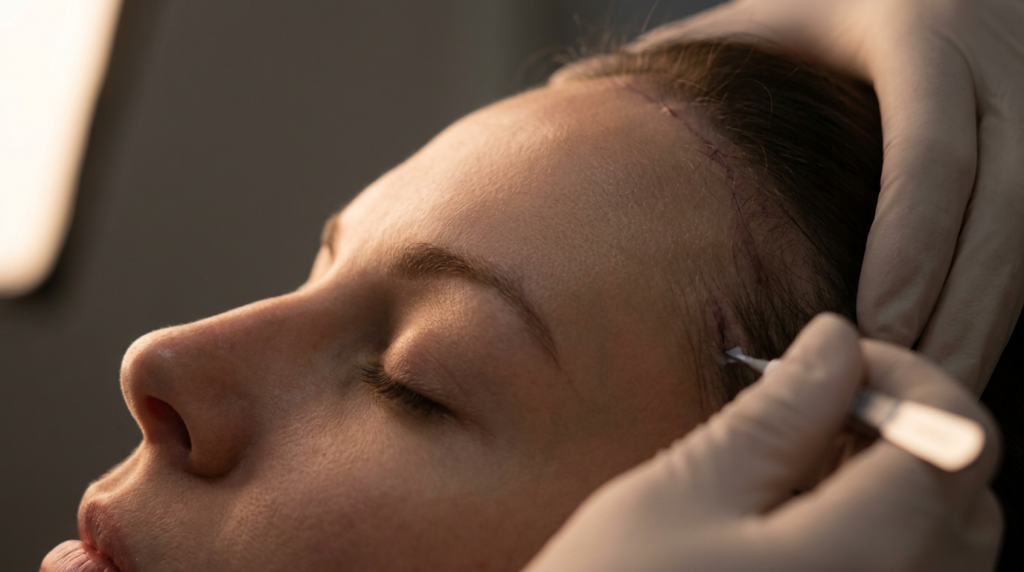
There is a common misconception in Facial Feminization Surgery – FFS that “shaving” is always safer than “breaking” the bone. In reality, Type I procedures (shaving/burring) are only effective for about 15% of patients. For the vast majority, the anterior table is too thin to allow for significant change through burring alone. Attempting to burr a thin bone results in a “window” into the sinus, which requires immediate grafting and often leads to an uneven surface. This is where Type III forehead reconstruction becomes the gold standard.
A Type III procedure involves a controlled osteotomy—removing the anterior wall of the frontal sinus entirely, reshaping it outside the body, and سپس fixing it back in a recessed position. This allows the surgeon to bypass the thickness of the bone entirely. Instead of being limited by how much bone we can remove, we are only limited by the depth of the sinus cavity itself. Specifically, the “safe limit” here is the distance between the current anterior wall and the back of the sinus cavity. If the cavity is 10mm deep, we can theoretically move the forehead back 8-9mm, leaving a small buffer for air circulation.
This technique also allows for superior Forehead Contouring & Brow Bone Reduction because it enables the surgeon to shape the orbital rims independently of the central bone plate. By detaching the bone, we can address the “bossing” or protrusion at the corners of the eyes, which is often the most masculine trait of the upper face. Consequently, the result is a smooth, continuous curve from the hairline to the bridge of the nose, a feat impossible with simple burring.
The ‘Safe Limit’ Calculation: Beyond the Anterior Table
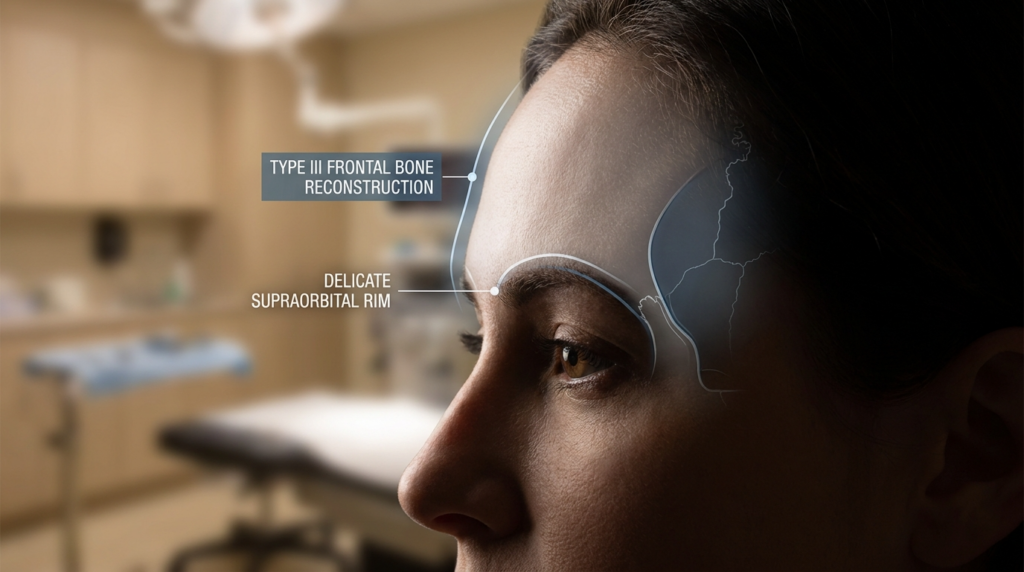
How does a surgeon calculate the “Safe Limit”? It is not a guess; it is a calculation based on three critical variables: the *diploic space* volume, the *anterior table* thickness, and the *frontonasal duct* position. To visualize this, imagine the forehead as a double-paned window. The safe limit is the maximum distance you can push the outer pane toward the inner pane without shattering the glass or blocking the airflow between them. In clinical practice, we maintain a minimum of 1-2mm of clearance from the posterior table to ensure no dural contact occurs.
Furthermore, the surgeon must account for the *bone burring limits*. Even in a Type III procedure, the edges of the orbital rims must be blended into the surrounding bone. If the bone is pneumatized (full of air pockets) far into the temple region, the safe limit for blending becomes much narrower. We use a “safety buffer” of 15% in all calculations. If the CT scan shows 10mm of available space, we plan for an 8.5mm setback. This prevents the bone plate from resting directly against the sensitive mucosal lining of the sinus, which could lead to chronic inflammation.
Modern precision requires moving away from the traditional “feeling” of the bone. High-resolution 3D CT reconstructions allow us to see the internal “struts” of the sinus. Some patients have a central septum (a wall) inside the sinus that provides extra structural support. If we remove this septum during the setback, we must ensure the remaining bone is stabilized with titanium micro-plates. Therefore, the safe limit is also a structural calculation: how much bone can we remove while still ensuring the forehead can withstand the pressure of everyday life?
Blind Setbacks vs. Guided Navigation: The Precision Revolution
Historically, surgeons performed “blind setbacks,” relying on anatomical landmarks visible to the naked eye. While experienced surgeons developed a “feel” for the bone, this method inherently carries a higher risk of error. A blind setback relies on the assumption that the sinus is symmetrical—which it almost never is. In many patients, one side of the sinus is significantly deeper or higher than the other. If a surgeon applies a symmetrical setback to an asymmetrical sinus, the result is either a crooked forehead or a dangerous breach on the shallower side.
Today, “guided setbacks” using intraoperative navigation have changed the paradigm. This technology functions like a GPS for the human face. By mapping the patient’s CT scan to their physical anatomy in the operating room, the surgeon can see the exact position of the surgical drill relative to the sinus walls in real-time. Specifically, when working near the *supraorbital nerve*, the navigation system alerts the surgeon as they approach the 1mm safety zone. This level of precision allows us to push the safe limit to its absolute biological maximum without crossing into the danger zone.
The use of ultrasonic bone cutting tools (like Piezosurgery) further enhances this safety. Unlike traditional saws, these tools only cut mineralized bone and stop immediately if they touch soft tissue like the sinus lining or nerves. By combining navigation with ultrasonic tools, we can perform Type III forehead reconstruction with surgical margins that were previously thought impossible. Consequently, patients receive the most feminine profile possible with a drastically reduced risk of long-term complications.
Comparative Analysis: Traditional vs. Navigation-Guided Setbacks
| Feature | Traditional (Blind) Setback | Navigation-Guided Setback |
|---|---|---|
| Measurement Accuracy | Visual estimation (~2mm margin) | Digital mapping (0.1mm margin) |
| Asymmetry Correction | Difficult; limited by visibility | Real-time tracking of both sides |
| Nerve Protection | Based on anatomical landmarks | Active proximity alerts |
| Sinus Health Risk | Higher risk of ostium blockage | Precise avoidance of drainage paths |
| Aesthetic Predictability | Variable based on surgeon’s eye | Highly predictable 3D outcomes |
As the table demonstrates, the shift toward technology-driven surgery isn’t just about speed; it is about the “Safe Limit.” In traditional surgery, the safe limit had to be very conservative to account for human error. With navigation, we can safely operate closer to the anatomical boundaries. This means a patient who might have only received a 4mm reduction under traditional methods can safely achieve a 7mm reduction with navigation, resulting in a significantly more transformative outcome.
Maintaining Sinus Integrity: The Role of the Ostium
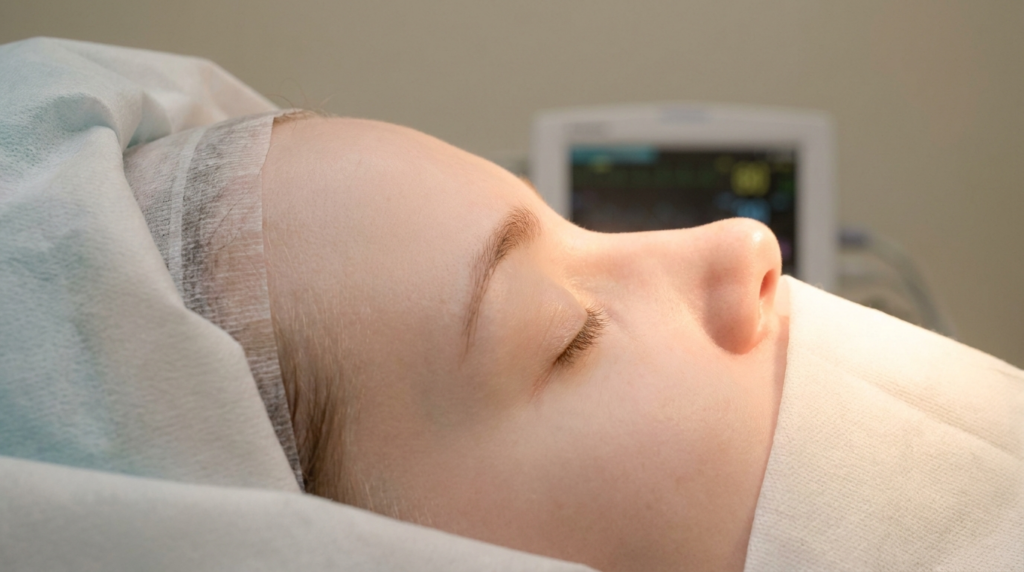
A successful forehead reconstruction is not just about what you remove; it is about what you preserve. The *sinus ostium* is the “exhaust pipe” of the frontal sinus. It allows mucus to drain into the nasal cavity. If the bone setback is too aggressive near the base of the forehead (the nasofrontal angle), the bone plate can “pinch” this opening. Specifically, if the ostium is narrowed to less than 2-3mm, the patient will develop chronic pressure and infections. This is a common reason for revision surgery in lower-quality FFS cases.
To prevent this, the “Safe Limit” calculation must include the vertical height of the sinus. In some individuals, the sinus is “low-slung,” meaning the drainage path is very close to the area requiring the most reduction. In these cases, the surgeon must perform a “modified Type III,” where the lower portion of the bone is left untouched while the upper portion is recessed. This preserves the plumbing of the face while still achieving the aesthetic goals. Specifically, the surgeon must ensure that the mucosal lining remains intact, as any scarring inside the sinus can lead to a “mucocele”—a cyst that can erode bone over time.
Post-operative care also plays a role in sinus health. We advise patients to avoid blowing their nose for at least three weeks after a Type III forehead reconstruction. Why? Because the air pressure can force bacteria from the nose into the freshly reconstructed sinus, or even push air under the skin of the forehead (subcutaneous emphysema). Following these biological rules ensures that the “safe limit” we calculated in the operating room remains safe during the healing process.
Your Surgical Roadmap: Preparing for Bone Reconstruction
If you are planning to undergo a significant brow reduction, you must take an active role in the planning process. The “Safe Limit” is not just a technical term; it is your insurance policy for a natural and healthy result. Follow these essential steps to ensure your surgeon is prioritizing your long-term safety over a “quick fix”:
- Demand a 3D CT Scan: Standard X-rays are insufficient. A high-resolution 3D CT scan is the only way to accurately measure the thickness of your anterior table and the depth of your sinus. If a clinic only uses 2D photos for planning, your safe limit is being estimated, not calculated.
- Ask About Navigation: Inquire if the surgeon uses intraoperative navigation or 3D-printed cutting guides. These tools significantly reduce the “blind” portion of the surgery and allow for a more aggressive yet safer setback.
- Discuss Sinus History: If you have a history of chronic allergies or sinusitis, your safe limit may be more restricted. Your surgeon needs to coordinate with your sinus anatomy to ensure the procedure doesn’t worsen these conditions.
- Review Type III Experience: Not all surgeons are comfortable with the Type III approach. Ask specifically how many reconstructions they perform monthly and what their protocol is for managing a sinus breach.
- Verify Stabilization Methods: Ensure the surgeon uses titanium micro-plates and screws to fix the bone. Some older techniques use wires or just sutures, which can lead to bone shifting and an audible “clicking” sound when you move your forehead.
By following this roadmap, you move from being a passive patient to an informed advocate. The goal of Type III forehead reconstruction is to eliminate dysphoria by creating a face that feels like home. When the math is right, and the safe limit is respected, the transformation is nothing short of miraculous. Ready to see what is possible for your profile? Contact our specialists today to begin your detailed anatomical mapping.
Frequently Asked Questions
What happens if the surgeon goes beyond the safe limit during a forehead setback?
Exceeding the safe limit can lead to several complications. If the anterior table is burred too thin, it may lead to ‘bone see-through’ or even a permanent hole (dehiscence). If the setback blocks the sinus ostium, the patient may suffer from chronic sinusitis or mucoceles. In extreme cases, pushing too far can even risk dural contact. This is why precise preoperative CT mapping is mandatory.
Is a Type III forehead reconstruction safer than a Type I shaving procedure?
Counter-intuitively, Type III is often safer for patients with thin bone. Attempting to shave (Type I) a thin anterior table leads to fragility and uneven results. A Type III reconstruction allows the surgeon to move the bone plate as a solid unit, preserving its structural integrity while achieving a much more significant aesthetic reduction than shaving ever could.
How does intraoperative navigation improve the results of brow bone reduction?
Intraoperative navigation acts as a GPS, showing the surgeon the exact position of their instruments relative to the patient’s internal anatomy. It allows for symmetrical setbacks in asymmetrical sinuses and provides proximity alerts when near the supraorbital nerves or the posterior table. This technology allows surgeons to safely reach the absolute maximum aesthetic limit for each individual.
Will a Type III forehead setback affect my breathing or voice?
While the frontal sinus is an air-filled chamber, its primary role in voice is resonance. Most patients notice no change in their speaking voice. However, the procedure must preserve the sinus ostium to ensure proper air and mucus flow. When performed within the safe limit, the ‘plumbing’ of the face remains intact, and breathing is completely unaffected.
 English (UK)
  English (United States)
  Spanish
  Dutch
Dutch  German
  Arabic
  French
  Russian