
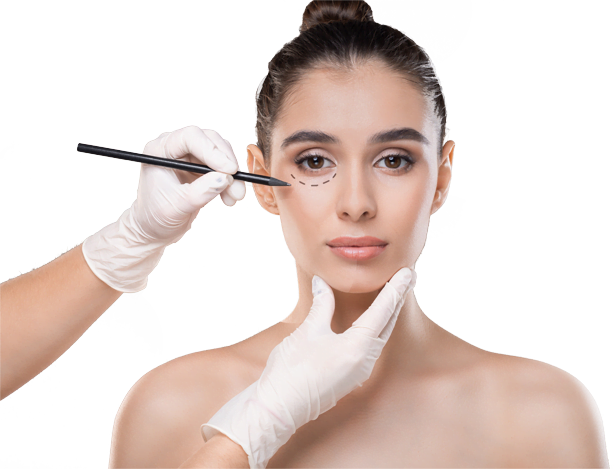


Cheek implants stand out as one of the most important procedures for facial feminization, especially for trans women. Understanding this procedure correctly and evaluating the process accurately is important in terms of results. Cheek implants are often misunderstood or confused with similar aesthetic approaches. When done correctly, they can make the face appear softer, more balanced, and more feminine; when poorly planned, they can lead to dissatisfaction.
In this article, we address what trans women considering cheek implants should expect and help them understand the potential risks as best as possible before embarking on this journey.
Table of Contents
1. What Do Cheek Implants Actually Do and Not Do?
Cheek implants enhance the projection of the cheekbone (malar region), bringing the midface forward. This method involves the surgical placement of solid, artificial pieces to define the natural contours of the cheeks. Implants are typically made of medical-grade silicone or porous polyethylene. These implants are placed on top of or in line with your cheekbones to add volume and create a more defined facial structure. Unlike temporary fillers, cheekbone implants are highly effective for those seeking permanent results. They are also one of the most important steps for trans women seeking a feminine cheek appearance.
However, it must be clearly stated: Cheek implants do not completely change the face; they support the feminine proportions of the face.
- They do not make the face feminine on their own.
- They do not solve sagging on their own.
- They are not suitable for every face type.
- Knowing these important points helps trans women considering this method to understand the risks correctly from the outset.
2. Surgical Risks Specific to Cheek Implants
Cheek implants carry fewer risks than other bone procedures within FFS, but they do carry some specific risks. The most common risks associated with this method are:
- Rarely, prolonged swelling,
- The implant being felt,
- Mild asymmetry that can occur with careless application
- Infection (rare),
- Implant displacement (very rare).
The rate of serious complications with cheek implants is 1–2%, while the rate of temporary side effects is around 15–25%. These rates are significantly reduced when the implant is placed in the correct size and position.
3. Possibility of Implant Displacement and Asymmetry
The most feared issue with cheek implants is the possibility of implant displacement. However, this risk is not as high or frightening as it is perceived to be.
- When properly secured, the risk of displacement drops below 1%.
- The possibility of slight asymmetry is only 3–6%.
Asymmetry is most often caused by:
- Differences in swelling,
- The natural asymmetry of facial muscles,
- Tissue reactions during the healing process.
Therefore, not all asymmetry is a “surgical error.” Asymmetry can also occur in the above situations.
4. Revision and Implant Removal Reality
One of the most beautiful and powerful aspects of cheek implants is that they can be revised. The revision procedure is usually performed in the form of minor adjustments. Depending on the complications that arise, the probability of revision is 5-8%. In rare cases, the implants can be completely removed. Cheek implants are a reversible procedure. This is a major source of psychological confidence for many trans women.
5. Psychological and Aesthetic Perception Risks
Cheek implants can sometimes feel “too obvious” in the first few months. This is usually temporary. However, for many people, it can lead to certain problems, especially psychologically. Possible emotional states:
- Feeling that “my face is too swollen,”
- Not being able to get used to looking in the mirror,
- Expectations being unrealistic.
Cheek implants integrate with the face over time; the results settle in over months. As with other FFS procedures, time and patience improve the results day by day.
6. The Most Critical Factors in Reducing Risks in Cheek Implants
It is possible to mention some factors that reduce the risks associated with cheek implants. Knowing these factors also helps in taking the right steps and setting realistic expectations. Here are those life-saving factors:
- Choosing implants that suit facial proportions,
- Avoiding excessively large implants,
- Placement suitable for bone structure,
- The surgeon’s FFS experience,
- Compliance with post-operative instructions.
Cheek implants that are properly planned and placed with great precision are among the procedures with high satisfaction rates.
7. What does Dr. MFO recommend regarding cheek implants?

Having worked with trans women in the field of FFS for a long time, Dr. MFO does not consider cheek implants a “standard step to be applied to everyone,” but rather a supportive procedure that completes the overall feminine balance of the face. The key points in Dr. MFO’s approach are as follows:
7.1. Cheek Implants Are Not Necessary for Every Face
According to Dr. MFO, in some faces:
- Forehead shaping,
- Mid-face fullness,
- Chin and jawline balance already sufficiently create a feminine appearance, so fat injection may yield more natural results instead of cheek implants. In other words, implants are not “mandatory” but rather based on need.
7.2. Small and Anatomical Implants Should Be Preferred
Dr. MFO emphasizes that in trans women, implants that are:
- Excessively large,
- Disproportionate to the face,
- Creating harsh transitions should be avoided.
The fundamental goal in his approach is: “Not to make the cheek noticeable, but to make femininity felt.” Therefore, anatomical implants that provide natural projection are prioritized.
7.3. Cheek Implants Are Not Evaluated in Isolation
Dr. MFO never considers cheek implants as an isolated procedure. The evaluation is based on the following questions:
- Is the forehead–nose–cheek transition smooth?
- Is the midface volume sufficient?
- How will the face change with age?
This holistic approach significantly reduces the risk of cheeks that later appear “too firm” or “masculine.”
7.4. Reversibility Is Clearly Explained to the Patient
Another issue Dr. MFO values is transparency. The patient is clearly informed that the cheek implant:
- Can be removed,
- Can be replaced if necessary,
- Revision is not a failure.
This approach provides psychological reassurance, especially for trans women who experience anxiety during the FFS process.
7.5. Adopted as the “Feminine But Not Exaggerated” Principle
Dr. MFO’s approach to cheek implants can be summarized in one sentence: “Making identity visible without changing the face.”
Therefore, the results generally progress along a line that is:
- Natural,
- Settles in over time,
- Creates a feminine perception without drawing attention in social life.
Cheek Implants Are Not a Scary Procedure

When performed correctly and by the right hands, cheek implants quietly but powerfully complete facial feminization. They work well with other FFS procedures and play an important role in a holistic approach to feminization. Their permanent results and practicality at every stage make them a preferred option.
However, as with any aesthetic surgical approach, this method has its own risks; but these risks are predictable, manageable, and often temporary.
We hope that this article has provided you with useful information and solutions to your problems, and has inspired you to pursue your dreams and goals. If you have any questions, comments, or feedback, please feel free to contact us or leave a comment below. We would love to hear from you and to help you in any way we can. Thank you for reading and have a wonderful day!Follow our blog for more. You can also reach us on our contact page for any questions you may have. Ffs center is an LGBT community friendly organization.
 English (UK)
  English (United States)
  Spanish
  Dutch
Dutch  German
  Arabic
  French
  Russian